
Smart Network Controller HiSm-LDSWG01
The command post for every shutdown device on the roof. Built on our in-house LDSW SOC, one unit manages ≥512 module-level nodes with a wireless downlink and 4G or wired uplink in redundancy. If the gateway drops out, the terminals still protect themselves — this unit organises, it does not backstop.
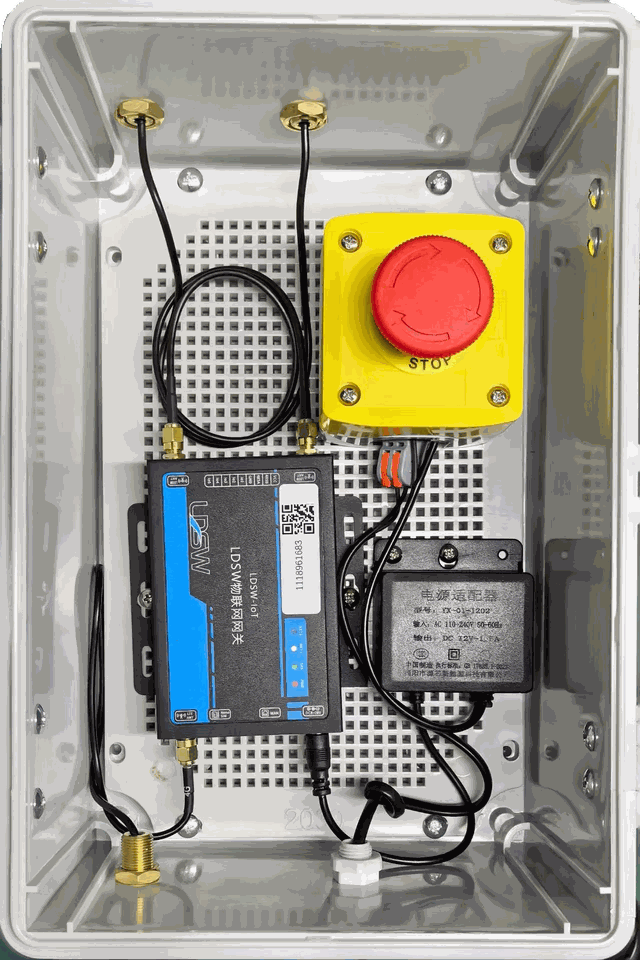
Downlink manages devices, uplink manages the channel
The value of a controller is not how many devices it can list, but whether it can deliver a command to every one of them at the decisive moment — and prove that it did.
Downlink · LDSW wireless mesh
- Built on our in-house LDSW SOC with an integrated low-duty-cycle wireless access protocol
- 2.4 GHz narrowband, published as China communications standard YD/T 6334-2025
- 300m+ effective coverage, ≥512 concurrent nodes per unit
- Cabling-free deployment — retrofits avoid a second conduit run
Uplink · dual-link redundancy
- 4G wireless and RJ45 wired in mutual backup; either path is enough to upload
- Local buffering during outages with automatic backfill on recovery — no data loss
- Remote firmware upgrade and policy push from the platform
- AES128 encrypted transport with role-based access control
Four ways a shutdown command reaches the device
Any one of them is sufficient. That is the difference between "it can be shut down" and "it will be shut down".
HiSm-LDSWG01 specification
Including interface definitions and site environment requirements for construction and acceptance checks.
| Parameter | Value / note |
|---|---|
| Model | HiSm-LDSWG01 |
| Downlink | LDSW wireless (2.4 GHz), standard YD/T 6334-2025 |
| Uplink | 4G wireless / RJ45 wired, dual-link redundancy |
| Nodes per unit | ≥ 512 module-level terminals |
| Effective coverage | 300m+ on complex sites |
| Core silicon | In-house LDSW SOC — protocol, chip, module and terminal all domestic |
| Control | Local and remote bidirectional, second-level shutdown response |
| Security | Physical E-stop · AES128 encryption · role-based access control |
| Power | AC 110V – 240V, standby draw < 1 W |
| Operating temperature | −40°C ~ +70°C |
| Operating humidity | ≤ 95% RH (non-condensing) |
| Ingress protection | IP65 outdoor enclosure |
| Interfaces | RF antenna · 4G antenna · SIM slot · RJ45 · power inlet · terminal block |
| Status LEDs | PWR power · NET1 LDSW downlink · NET2 uplink |
Where it goes and how it's commissioned — spelled out
Installation & interfaces
- Mount 1.5 – 2 m above ground, clear of metal obstructions and strong EMI
- Aim antennas toward dense array areas to minimise structural shadowing
- 4G mode requires a valid SIM; RJ45 mode connects to the site network
- QR-code binding assigns node ownership on the spot
Commissioning & O&M
- Policy threshold configuration, one-click shutdown and group management
- Remote firmware upgrade from the platform — no site visits per unit
- Monthly checks: link status, online rate, communication success rate
- Annual service: enclosure sealing, antenna torque, contact oxidation
The controller is never bought standalone — it ships with the design
Roof link survey, node density calculation, antenna placement guidance and acceptance criteria, delivered together with shutdown devices and the cloud platform.