
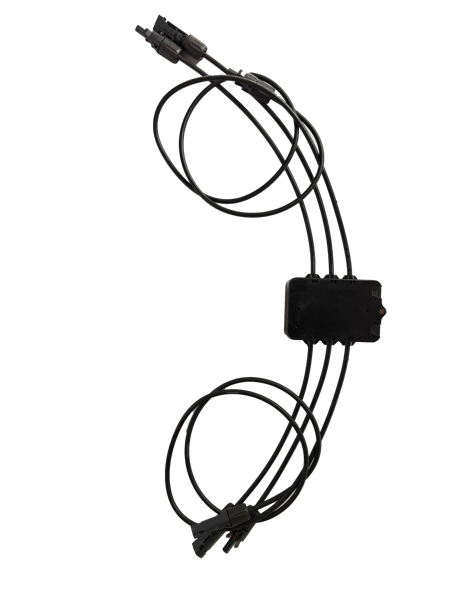
HiSRSD Module-Level Smart Shutdown Device
A compact device mounted on the module frame that pulls DC-side risk from nearly 1,000 V down to below 1 V. It keeps working when the network does not — on-device TinyML completes shutdown within 25 seconds, independent of cloud, gateway or connectivity.
If the string doesn't go to zero, no firefighter goes on the roof
NEC 690.12 has tightened repeatedly because in real fires the hazard is rarely the flame — it is the live DC conductor on the roof. String-level shutdown leaves dozens of volts behind. That is not safety, that is minimum compliance.
Residual risk of string-level shutdown
- Only the string output is cut; series voltage across modules remains, up to nearly 1,000 V
- Array-external voltage typically stays around 80 V — the NEC floor, not a safety margin
- At night or under cloud, de-energisation cannot be proven; crews must assume live conductors
- Fault localisation is manual; hotspots and arcs are often found only after ignition
How HiSRSD handles it
- One device per two modules, dismantling voltage right down to module level
- Array-external voltage ≤1 V after shutdown — no dangerous potential on a multimeter
- Wireless command, power-loss trigger and fire-service interlock — any one path is enough
- Full per-module voltage, temperature and yield data; anomalies surface in seconds
Device, gateway, platform — one chain, end to end
The device acts, the controller organises, the platform keeps the record. Each layer ships independently or as a complete site package.
HiSRSD1V2-A full specification
Structured for design-office selection, procurement clause checks and acceptance criteria.
| Parameter | Value | Note |
|---|---|---|
| Array-external voltage after shutdown | ≤ 1 V | Far below the 80 V ceiling in NEC 690.12 |
| Shutdown response time | ≤ 25 s | Faster than the 30 s mandated by NEC |
| Single-unit shutdown time | 15 s | Per-device actuation time |
| Residual output per unit | 1.6 – 2 VDC | Safe potential, no shock hazard |
| Communication | LDSW wireless (2.4 GHz) | China standard YD/T 6334-2025, cabling-free |
| Offline autonomy | TinyML edge intelligence | Autonomous protection without connectivity (patent ZL 2025 1 0001839.5) |
| Module-level data | Voltage / temperature / yield | Full sampling, not polling |
| Maximum output power | 1600 W (800 W × 2) | 1-to-2 architecture |
| Conduction efficiency | > 99.8% | Negligible yield loss |
| Ingress protection | IP68 (Class II) | Long-term outdoor operation |
| Operating temperature | −40°C ~ +85°C | Covers tropical through to cold climates |
| Design life | 25 years | Matched to module lifetime |
| Dimensions / weight | 110 × 73 × 23 mm / 536 g | Lightweight, minimal rail load |
| Connector / certification | MC4 | CE · NEC2017 · IEC62109 | Fast field termination, standards complete |
| Nodes per system | ≥ 512 | Single-gateway concurrency |
| Terminal cost per watt | 0.05 – 0.08 CNY / W | Varies with project scale |
When the network fails, protection must not
In real PV failures, "comms lost" and "shutdown needed" tend to happen together — fire burns through cabling, an inverter trips, extreme weather drops the backhaul. Putting the protection logic in the cloud hands the last line of defence to the least reliable link.
On-device decision making
- TinyML model runs in the terminal MCU, no cloud inference required
- Power loss triggers shutdown by default — fail-safe by design
- Local criteria: voltage anomaly, thermal rise, arc signature
- Patent ZL 2025 1 0001839.5 granted; the approach is protected
Fail-safe by design
- Default state is open; conduction requires an explicit command
- No hazardous voltage during installation or servicing
- Gateway outage does not stop device-level protection — degraded, not disabled
- Offline nodes raise their own platform alarm, preventing silent failure
Key differences against mainstream approaches
Not to disparage alternatives — but so that every difference is understood together with its cost.
| Dimension | HiSRSD V2 | Module optimiser / smart module | Microinverter | Conventional RSD |
|---|---|---|---|---|
| Array-external voltage after shutdown | ≤ 1 V | ~20 V | Low-voltage AC during operation | ≤ 80 V (NEC floor) |
| Shutdown response | ≤ 25 s | 10 – 25 s | Architecture dependent, no standalone shutdown | ≤ 30 s |
| Communication | LDSW wireless (YD/T 6334-2025) | PLC powerline (proprietary) | PLC / RF | PLC / RS485 |
| Offline autonomy | TinyML edge intelligence | Gateway / cloud dependent, degrades offline | Local link dependent | Gateway dependent, no edge autonomy |
| Module-level data | Full voltage / temperature / yield | Optimisation + sensing (closed protocol) | Yield only | Limited / none |
| Supply chain | In-house SOC, fully domestic | Partly domestic | Partly import dependent | Mixed supply chain |
| Retrofit intrusion | Wireless, no outage required | Cabling work needed | Inverter replacement | Cabling work needed |
| Number of terminations | ~50% fewer than conventional | Standard | Highest | Standard |
| Terminal cost per watt | 0.05 – 0.08 CNY / W | High | Highest | Medium |
Note: competitor figures are drawn from public sources, vendor documentation and third-party test reports (including TÜV shutdown testing and NEC 690.12 clauses). For selection reference only; latest vendor disclosures prevail.
New build or retrofit, it lands either way
C&I distributed rooftops
Factory, campus and logistics roofs with dense strings and frequent servicing — module-level shutdown directly cuts electrical risk for O&M crews.
Public buildings & rail
Schools, hospitals and metro depots where fire acceptance and emergency interlock are strict and de-energisation must be provable.
Overseas retrofit
Wireless, cabling-free and installable without outage — suited to safety-compliance upgrades on operating plants.
PV + storage projects
Shares its base with the CS-500 suppression system, giving generation and storage a single safety ledger.
Run a sample on a real roof first, then decide
Sample testing, site link surveys, configuration proposals and acceptance criteria, with support for design-office and fire-authority coordination.